
Embedded Systems Question Bank
Comprehensive academic repository covering all 9 course slide modules (Lessons 1 to 11), 4 full assignments with high-resolution labeled circuit diagrams, and 3 university-standard mock examination papers with complete marking schemes and model answers.
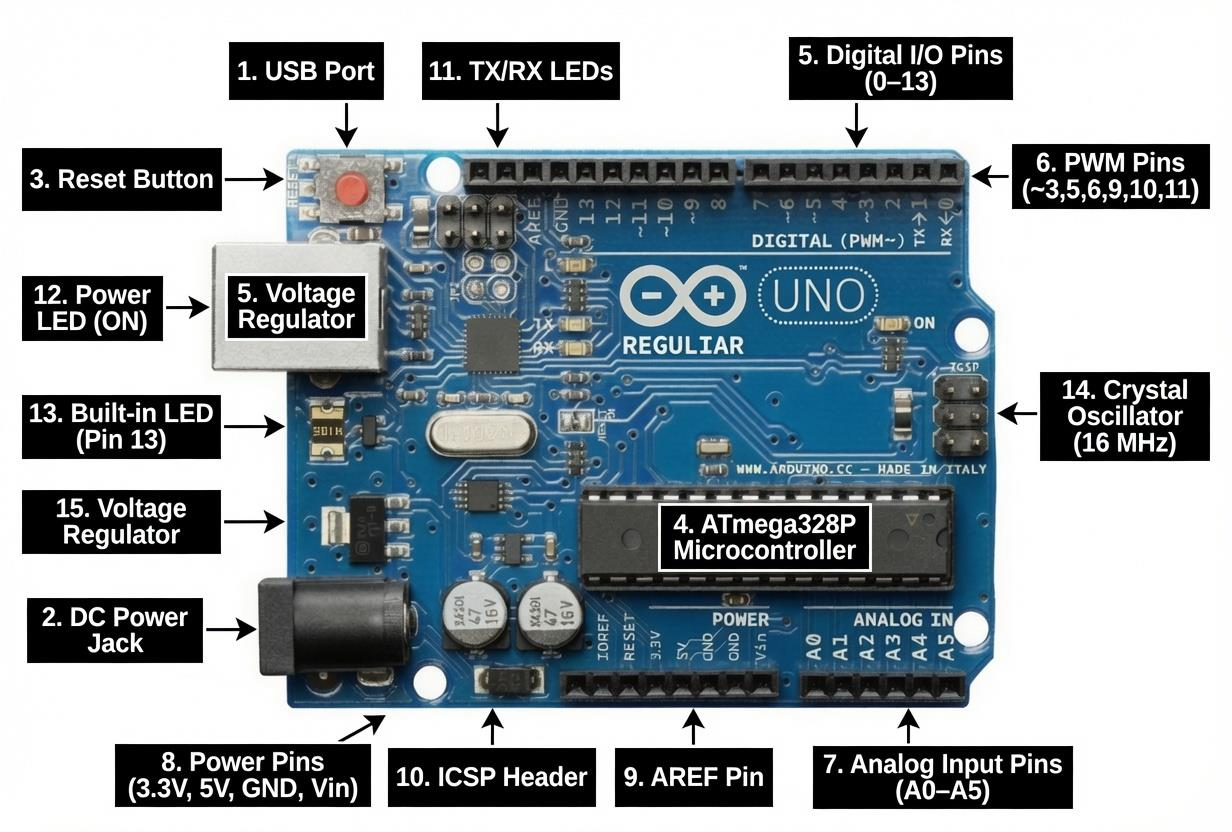
Hardware Architecture & Interfacing Map
ATmega328P Pinout, GPIO Registers & Power Rails
Assignment 1: Fundamentals, Characteristics & Architecture
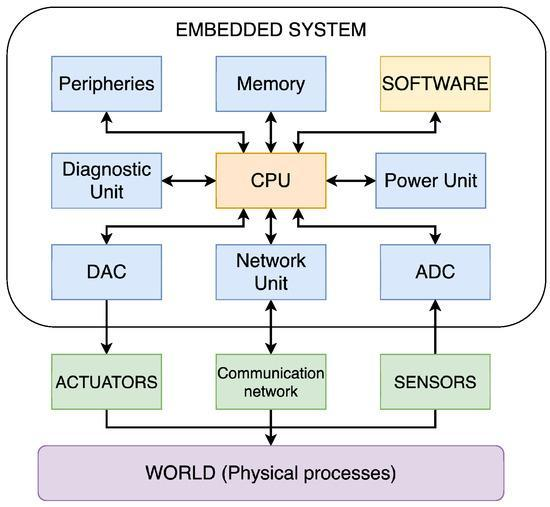
Figure 1.1: Core Hardware Architecture of an Embedded System (CPU, Memory, Sensor Inputs & Actuator Outputs).
Question 1: Definition & Four Core Characteristics
(a)Define an Embedded System in clear, professional technical terms.
4 MarksAn embedded system is a specialized combination of computer hardware and dedicated software (firmware) designed to perform a dedicated, single function or narrow set of tasks within a larger electrical or mechanical system, often operating under strict real-time constraints.
(b)State and explain FOUR core characteristics of embedded systems.
4 MarksEmbedded systems differ fundamentally from general computers across four pillars:
- 1. Single-Function Purpose: Executes one dedicated program repeatedly for its entire operating lifetime rather than multi-purpose software.
- 2. Real-Time Determinism: Must process inputs and respond within strict, guaranteed time deadlines (e.g. airbag deployment).
- 3. Resource & Power Constraints: Operates on tightly restricted RAM/ROM and minimal electrical power (mW to Watts).
- 4. High Reliability & Autonomy: Engineered to run 24/7/365 without crashing, freezing, or requiring human reboot intervention.